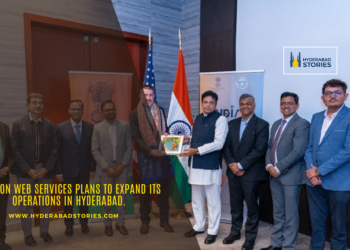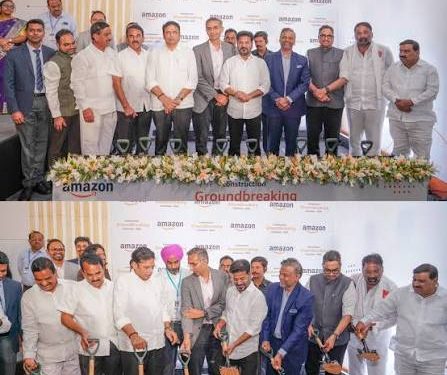
On any ordinary Wednesday, the peripheral landscape of Hyderabad is a quiet expanse of potential. But yesterday, it became the epicenter of Telangana’s future.
With the clink of a ceremonial trowel, Chief Minister A. Revanth Reddy laid the foundation stone for Amazon Web Services’ (AWS) newest mega data center. What started as a celebratory milestone for a ₹60,000 crore deal inked at the Telangana Rising Global Summit 2025 quickly turned into something far more ambitious: a direct, public challenge to one of the world’s richest companies to think even bigger.
“I want Amazon to invest ₹1 lakh crore,” CM Revanth Reddy asserted, looking beyond AWS’s current $7 billion commitment. “Only then can we reach our goal of a $1 trillion economy by 2034.”
It’s a bold pitch, but in Telangana, the government isn’t just asking for capital—they are redesigning the entire state to support it.
Breaking the Chains of “Policy Paralysis”
For years, global corporations looking to expand in India have had to navigate a labyrinth of red tape, subjective approvals, and “pick-and-choose” incentive schemes. Under the newly launched Telangana Rising 2047 policy framework—which featured design inputs from heavyweights like World Bank President Ajay Banga—that bureaucratic bottleneck is being dismantled.
To prove he means business, the Chief Minister announced a relentless new administrative rhythm: monthly review meetings dedicated entirely to clearing investor hurdles. Former Chief Secretary and current Government Advisor K. Ramakrishna Rao has been tasked with holding monthly direct sessions with Amazon executives to fast-track every expansion request.
“Policy paralysis and a ‘pick-and-choose’ method of granting permissions will not benefit the State. We have come up with sector-specific policies to ease the difficulties of investors.” — A. Revanth Reddy, Chief Minister of Telangana
Introducing the CURE, PURE, and RARE Model
As Hyderabad scales rapidly to accommodate the artificial intelligence and data boom, a critical question looms: How do we grow without destroying our quality of life?
Unlike other Indian megacities grappling with crushing traffic gridlock, smog, and infrastructure failures, Telangana is pioneering a layered, regional development strategy categorized into three distinct zones:
-
CURE
-
PURE
-
RARE
By dividing industrial, residential, and green zones, the government intends to insulate citizens from pollution and traffic congestion while building world-class manufacturing and tech hubs. The anchor for this vision is the upcoming Bharat Future City, with Amazon serving as the crown-jewel tenant destined to attract other Fortune 500 giants.
“We Are Facilitators, Not Regulators”
Echoing the Chief Minister’s aggressive growth mindset, IT and Industries Minister D. Sridhar Babu emphasized that the state has shed its identity as a rigid regulator. Instead, it is acting as an active business partner.
Addressing the critical infrastructure needs of data centers—which require astronomical amounts of power and water to keep global AI systems running—Sridhar Babu announced the establishment of a dedicated Data Center Park at Aloor. The park will feature robust, uninterrupted utility corridors designed specifically to shield tech companies from operational downtime.
“We have embarked upon a mission to make Telangana a $3 trillion economy by 2047,” Sridhar Babu noted. “It is not a simple mission, and we need partners like Amazon in our pursuit.”
The 10% Contribution to Viksit Bharat
Telangana’s roadmap is intimately tied to India’s national destiny. With Prime Minister Narendra Modi aiming for a $30 trillion Viksit Bharat (Developed India) by 2047, Telangana has positioned itself to shoulder a massive 10% of the entire country’s GDP ($3 trillion) by the same deadline.
With its strategic location, a state government willing to move at the speed of private enterprise, and a structured layout to prevent urban decay, Hyderabad is no longer just competing with Bangalore or Mumbai.
As Chief Minister Reddy confidently put it: “We are creating facilities for investors so that we can compete with China.”
Yesterday, a foundation stone was laid in the soil of Hyderabad. But the blueprint drawn up stretches far into the clouds.