A brain tumour diagnosis has historically been a phrase that instantly evokes a paralyzing sense of fear. For decades, the primary objective of neurosurgery was straightforward yet brutal: remove the mass, and minimize the immediate risk to life. However, the delicate geography of the human brain meant that saving a life often came at a staggering cost to the patient’s vital faculties—sometimes compromising speech, memory, or movement.
Today, a quiet revolution is taking place in Hyderabad’s premier medical corridors. Leading neurosurgeons across the city are utilizing a sophisticated blend of Virtual Reality (VR) and Artificial Intelligence (AI) to fundamentally shift the paradigm of treatment from mere survival to complete functional preservation.
On the occasion of World Brain Tumour Day, local health experts highlighted how Hyderabad has grown into a major hub for these advanced, real-time surgical innovations.
Stepping Inside the Brain: Pre-Surgical VR Mapping
Imagine a surgeon stepping inside a patient’s brain to map out a route before ever picking up a scalpel. This is no longer the realm of science fiction.
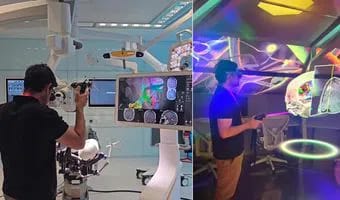
Even before making a single incision, Hyderabad’s neurosurgeons now don high-tech VR headsets to navigate a three-dimensional, color-coded, high-definition “digital twin” of a patient’s brain. This immersive window allows them to visualize exactly where the tumour sits in relation to critical neural pathways, protecting healthy tissue well ahead of the procedure.
Once inside the operating theater, the magic of integration takes over:
-
Robotic Navigation Systems: Functioning like a highly advanced GPS for the anatomy, guiding the surgeon’s instruments with sub-millimeter precision.
-
Specialized Microscopes: Overlaying the pre-mapped 3D digital models directly onto the real-time physical structures of the brain.
-
Connectomics-Guided Mapping & Lasers: Working in tandem to ensure maximum tumour removal while leaving surrounding cognitive networks completely untouched.
Reaching Deep Tumours Through Natural Corridors
The evolution is not just in how surgeons see, but in how they access the target. Traditional, highly invasive cranial surgeries are increasingly being replaced by minimally invasive routes that navigate the brain’s natural pathways.
“A combination of early detection and advanced treatment definitely leads to better outcomes,” explains Dr. Abhirama Chandra Gabbita, a senior neurosurgeon and neuro-oncology and skull base specialist practicing in Hyderabad. “Advanced endoscopic transorbital and endoscopic skull base approaches allow surgeons to reach selected tumours through natural anatomical corridors, often minimising or avoiding manipulation of normal brain tissue.”
By accessing tumours through these natural pathways—such as through the nasal passages or tiny folds around the eyelid—surgeons dramatically reduce the physical footprint of the operation. For the patient, this translates to smaller scars, significantly less post-operative pain, lowered risk of infection, and substantially shortened hospital stays.
A New Horizon of Hope
As Hyderabad solidifies its status as a global medical and technological powerhouse, its healthcare landscape reflects a beautiful truth: technology is at its best when it serves humanity.
The convergence of AI, virtual reality, and exceptional surgical expertise means that patients facing a brain tumour diagnosis can look forward to the future not with fear, but with a well-founded hope for a full, vibrant recovery. The goal in Hyderabad is no longer just about extending life—it is about ensuring the patient returns to their life with their memory, speech, and identity completely intact.