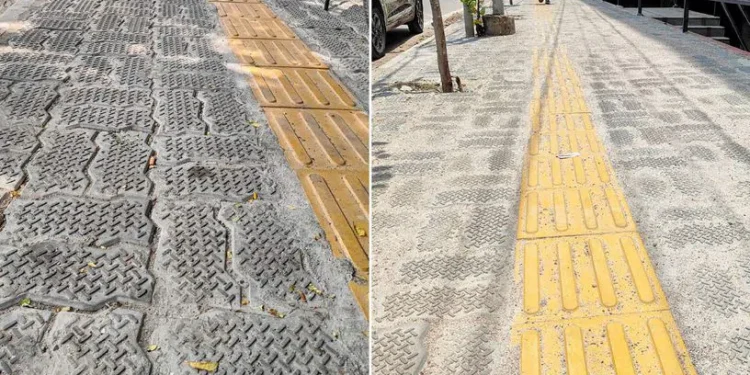
If you’ve taken a stroll between Somajiguda Circle and the Necklace Road MMTS Station recently, you might notice the ground beneath your feet feels a little different. It’s smoother, has an excellent grip, and stays remarkably cool despite the Telangana sun.
What you are walking on isn’t traditional concrete. It is Hyderabad’s first-ever footpath made entirely from recycled plastic paver blocks—a brilliant pilot project by the Greater Hyderabad Municipal Corporation (GHMC) that is redefining how the city handles waste.
The Recipe: From Snack Wrappers to Sidewalks
Every day, millions of pieces of single-use plastic—chip bags, water bottles, caps, and thin polybags—find their way into the city’s landfills. The Khairatabad Zone GHMC officials decided to intercept that waste stream and turn it into a building block.
These innovative pavers are engineered with a specific formula:
-
65% to 70% Post-Consumer Plastic: Primarily Low-Density Polyethylene (LDPE) and High-Density Polyethylene (HDPE).
-
30% to 35% Fillers and Minerals: Added to provide structural integrity, weight, and bind the melted plastic into a rock-solid compound.
Instead of sitting in a dump for centuries, two kilometers of discarded plastic trash have officially been locked into a functional, highly durable public walkway.
Why Plastic Outperforms Concrete
It sounds counterintuitive to build a road out of plastic, but from an engineering perspective, these blocks outperform traditional cement tiles across almost every metric.
1. Built to Last (and Easy to Fix)
Traditional concrete tiles crack easily under pressure or weather erosion, requiring massive jackhammers and costly street closures to fix. The new plastic blocks are inherently flexible and completely waterproof. If utility workers need to dig up a pipeline underneath, the modular blocks can simply be lifted out individually and slotted back into place like Lego pieces.
2. Pedestrian Safety First
Monsoon season in Hyderabad often turns sidewalks into slippery hazard zones. The textured composition of these plastic pavers offers superior grip, significantly reducing slip-and-fall risks during heavy downpours. Furthermore, they feature tactile pathing to assist visually impaired pedestrians.
3. Beating the Summer Heat
Concrete holds onto heat long after the sun goes down, worsening the city’s “urban heat island” effect. Because of the mineral-filler mix and the physical properties of the treated polymers, these plastic paver blocks don’t absorb or generate nearly as much thermal heat, making your summer evening walks significantly more comfortable.
What’s Next for the City?
The GHMC isn’t stopping at Somajiguda. With the first two-kilometer stretch successfully laid down, works are commencing immediately on a second pilot stretch in Jubilee Hills near Bharatiya Vidya Bhavan. The municipal corporation also plans to install informative signboards along the walkways so everyday commuters can see exactly how the city’s trash is being put to work.
If this pilot proves successful in the long run, it could set a massive precedent for green infrastructure across India—proving that the solution to our plastic crisis might just be right beneath our feet.
Have you walked on the new Somajiguda footpath yet? Let us know what you think of the grip and texture in the comments below!