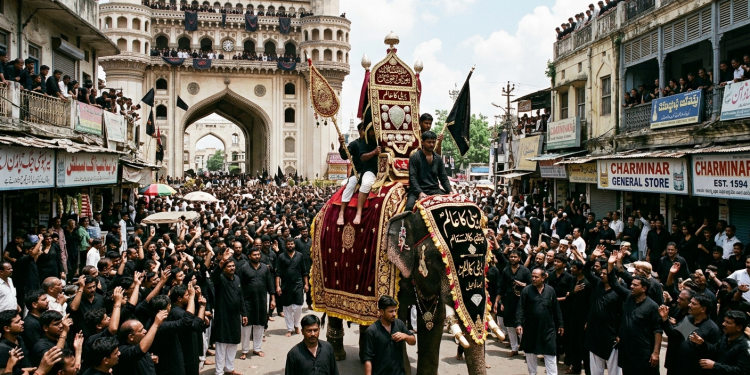
Every year on the 10th day of Muharram (Ashura), a profound stillness falls over the bustling lanes of Hyderabad’s Old City, giving way to the rhythmic, somber echoes of mourning. At the center of it all is a majestic, caparisoned elephant carrying a sacred standard—the Bibi-ka-Alam.
For over four centuries, this grand five-kilometer procession from Dabeerpura to Chaderghat has stood as the pinnacle of Hyderabad’s Muharram observances. It is not merely a religious event; it is a living tapestry of the city’s unique Ganga-Jamuni tehzeeb (communal harmony), drawing thousands of devotees, history buffs, and onlookers from all faiths and corners of the country.
📜 From Golconda to Dabeerpura: A Royal Lineage
The roots of the Bibi-ka-Alam are deeply intertwined with the very foundation of Hyderabad, bridging two glorious eras—the Qutb Shahis and the Asaf Jahis (Nizams).
As Prof. Salma Ahmed Farooqui from the H.K. Sherwani Centre for Deccan Studies notes, the religious legitimacy and rituals surrounding the event were established during the Qutb Shahi period. It began when the devout wife of Sultan Muhammad Qutb Shah installed an alam (sacred standard) in the old fort city of Golconda to honor Bibi Fatima, the daughter of Prophet Mohammed.
Generations later, during the Asaf Jahi era, the standard was moved to the plains and housed in a specially constructed monument: the Bibi-ka-Alawa in Dabeerpura, where it is heavily guarded and revered to this day.
💎 Sacred Relics and Nizami Treasures
What makes the Bibi-ka-Alam completely unique is the priceless heritage physically attached to it:
-
The Relic from Karbala: The Alam houses a deeply sacred fragment of the wooden plank believed to have been used for the final ablution of Bibi Fatima before her burial. Historical tradition holds that this relic traveled from Karbala (in modern-day Iraq) to the Deccan during the reign of Sultan Abdullah Qutb Shah.
-
The Nizam’s Diamonds: The standard carries unparalleled royal splendor. Mir Osman Ali Khan, the 7th and last Nizam of Hyderabad, adorned the Alam by donating six magnificent diamonds alongside emeralds and other precious gems. These royal jewels are preserved in distinct black pouches fastened directly to the standard.
📍 Halts of History: The Procession Route
Beginning around noon on Friday, the grand procession moves at a solemn pace, led by the elephant and accompanied by barefoot, bare-chested mourners representing nearly 50 anjumans (Shia mourning groups).
To walk this five-kilometer route is to walk through Hyderabadi history itself, pausing at landmarks that trigger age-old protocols:
| Milestone Halt | Location | The Ritual |
| First Stop | Ashoorkhana Khadam-e-Rasool | Devotees offer prayers before the revered, displayed footprints of Prophet Mohammed. |
| Second Stop | Peeli Gate, Purani Haveli | In a nod to royal history, a representative of the Nizam’s family steps forward to offer a traditional dhatti (ceremonial offering) to the Alam. |
| Third Stop | Alawa-e-Sartouq Mubarak | Located near the Darulshifa playground, this is a powerful emotional pause where women gather inside to participate in matam (mourning). |
| Fourth Stop | Azakhana Zehra | A final, grand ceremonial dhatti is offered by the Nizam Trust before the procession snakes past Charminar toward Chaderghat. |
🐪 The Echoes of Karbala: Tabarrukat
Following the main elephant is a mesmerizing caravan of smaller standards known as Tabarrukat. Carried aloft by devotees on foot or mounted on the backs of camels, these smaller alams represent the various martyrs and tragic events of the Battle of Karbala. They form a hauntingly beautiful visual chronicle that has remained unchanged for centuries.
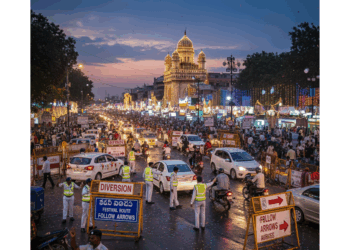
A Quick Tip for Attendees & Commuters: > If you plan to witness this historic event, note that the Hyderabad Traffic Police enforce strict diversions from 12:00 PM to 10:00 PM on Friday around Dabeerpura, Charminar, and Nayapool. It is best to approach the area on foot and respect the solemnity of the occasion.
Ultimately, the Bibi-ka-Alam procession is a reminder of what makes Hyderabad truly magical. Empires have risen and fallen, and the city has transformed into a modern tech hub, but the heartbeat of its old quarters remains tethered to a 432-year-old promise of remembrance, culture, and unity.