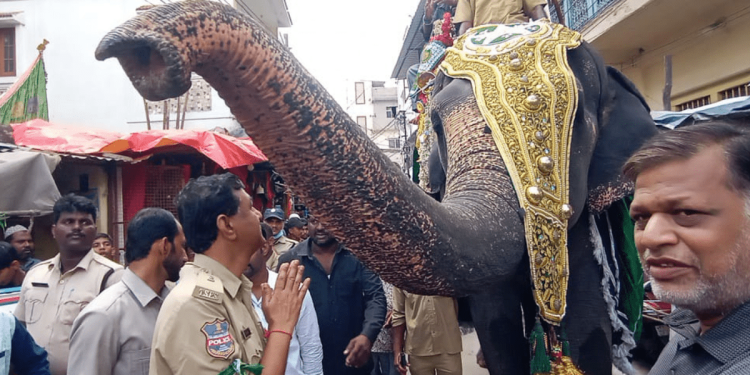
A somber atmosphere envelops the historic lanes of Dabeerpura in Hyderabad’s Old City every year as the Islamic month of Muharram begins. Thousands of devotees, predominantly clad in black, converge upon the Bibi-ka-Alawa to catch a glimpse of the Bibi-ka-Alam—a highly revered sacred standard. While this deeply moving tradition is a central anchor of Hyderabad’s cultural fabric, its journey from an exclusive, dynastic Shia relic into a grand, state-wide institution is a fascinating tale of history, legal transformation, and strategic political patronage.
The story of the Bibi-ka-Alam reveals how successive ruling dynasties shaped the Ganga-Jamuni tehzeeb (communal harmony) that defines Hyderabad today.
The Qutb Shahi Genesis: Relics and Rituals
The institution of Azadari (the ritual mourning of Muharram) was originally institutionalized as a state-supported practice under the Shia Qutb Shahi rulers of Golconda. Historical traditions maintain that the sacred relic at the heart of the Bibi-ka-Alam reached the Golconda Kingdom during the reign of Sultan Abdullah Qutb Shah.
According to historical archives, this priceless relic is a piece of the wooden plank used for the ritual funerary cleansing of Bibi Fatima, the daughter of Prophet Muhammad, before her burial in Medina. The relic was carved into a wooden tughra (calligram) inscribing the sacred names of Allah, Muhammad, and Ali, and covered in a protective gold and brass alloy. Therefore, the foundational religious legitimacy, the physical relic, and the early ritual traditions of the Bibi-ka-Alam were entirely Qutb Shahi creations.
The Asaf Jahi Transformation: From Royal Relic to Civic Icon
When the Sunni Asaf Jahi dynasty (the Nizams) inherited the administration of Hyderabad, they did not dismantle the Shia institutions of their predecessors. Instead, they recognized the deep cultural resonance of these practices and chose to expand them. What transformed the Bibi-ka-Alam from an exclusive dynastic token into Hyderabad’s most visible public Muharram observance was sustained Asaf Jahi patronage.
This evolution hinged on three crucial developments:
1. The Relocation to Dabeerpura
During the Asaf Jahi period, the alam was moved from its original, restrictive setting inside Golconda Fort to a newly designated public center at the Bibi-ka-Alawa in Dabeerpura. An inscription on the main door of the structure is dated 1784, marking its formal establishment as a major public ritual hub under the Nizams.
2. Lavish Royal Endowments and Jewels
Successive Nizams systematically enriched the alam with magnificent gifts. Historical accounts record extensive donations of precious stones and ornaments by the Nizams’ immediate family. Most notably, the seventh Nizam, Mir Osman Ali Khan, presented six pristine diamonds and an array of priceless jewelry. Today, these jewels are kept in six black pouches and affixed to the standard during the procession, resembling dangling emerald earrings to the looking devotee.
3. Public Ceremonial Participation
The most critical factor linking the state to the ritual was the personal participation of the ruling family. By publicly offering dhatti (ceremonial cloths) and gifts to the alam, the Nizams bound the political legitimacy of the Hyderabad state to the sacred observances of Muharram.
Guarding the Legacy: The 1951 Legal Transition
Over time, this intense royal patronage reshaped the legal status of the Bibi-ka-Alawa, moving it far beyond a standard waqf (pious endowment). On March 29, 1951, the seventh Nizam, Mir Osman Ali Khan, formalized this arrangement by signing the Bibi-ka-Alam and Koh-e-Maula Trust—one of 33 distinct private trusts he established to preserve his historic legacy.
Prior to 1950, the upkeep of the sacred sites was managed by the Ecclesiastical Department of the Nizam’s personal estate (Sarf-e-Khas). The 1951 trust deed modernized this structure, setting aside government securities with a total face value of ₹3,00,000 specifically for the Bibi-ka-Alam. From this corpus, the deed earmarked an annual sum of ₹3,00,000 for physical maintenance and ₹1,000 for annual ritual offerings.
Crucially, the deed mandated that the trust must fund the expenses incurred during the first week of Muharram, explicitly highlighting the grand procession on the 10th day (Yom-e-Ashura), when the alam is carried through the city streets atop a caparisoned elephant. Signed in the presence of M.K. Vellodi, the then-Chief Minister of Hyderabad, and N.K. Suntook, a solicitor from Bombay, the trust appointed an inaugural Advisory Committee comprising Nawab Shaheed Yar Jung Bahadur, Moulvi Mahomed Abdus Sattar Saheb, and Humayun Ali Baig to oversee the execution of these traditions.
An Enduring Symbol of Hyderabad
Today, the Bibi-ka-Alam operates within a modern legal framework managed jointly by H.E.H. the Nizam’s Trust and the Telangana State Waqf Board. While many Qutb Shahi ashurkhanas have survived the test of time, only the Bibi-ka-Alam achieved unmatched, city-wide prominence.