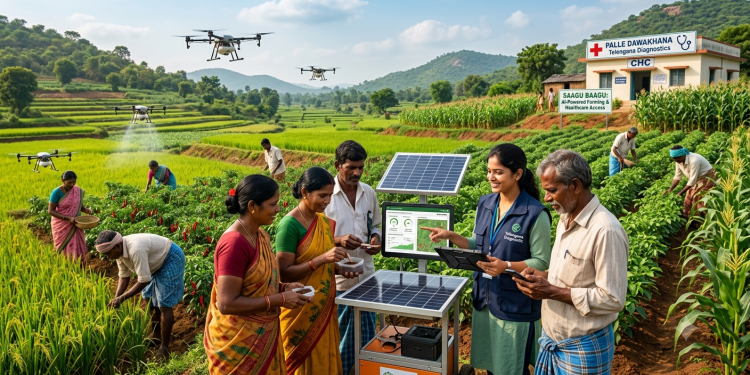
Walk into any premier corporate hospital in Gachibowli or Jubilee Hills, and you are immediately surrounded by cutting-edge medical infrastructure. Hyderabad has firmly established itself as a global healthcare and technology powerhouse. Yet, step just 100 kilometers outside the outer ring road into rural Telangana, and the reality changes drastically.
According to recent macroeconomic data, our rural Community Health Centres face a staggering shortage of 79 specialists. With only 37 specialists in position against a requirement of 116, a pregnant woman or a sick child in a remote village often has to travel hours just to see a gynecologist or pediatrician.
But a landmark global report titled “AI for All”—released by consulting giant BCG and tech investor Prosus—suggests the solution to this gap isn’t just about waiting for more doctors to graduate. It’s about rewriting the rules of access using Artificial Intelligence. And interestingly, the blueprint for fixing rural healthcare is already working right now in Telangana’s mud-stained fields.
The Lessons of “Saagu Baagu”
To understand how AI can save lives in a clinic, we first have to look at how it is changing lives on the farm.
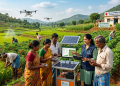
For decades, smallholder farmers have lacked access to scientific soil testing and personalized expert advice. Enter Saagu Baagu (meaning “agricultural advancement”), a pioneering project launched by the Telangana government in collaboration with the World Economic Forum.
Instead of requiring farmers to travel to distant labs, Saagu Baagu brought rapid, machine-learning-based soil diagnostics directly to the fields. Personalized, data-driven crop advisories were sent straight to farmers’ phones via WhatsApp—an app they already knew how to use.
The results? A 9% reduction in pesticide use and massive, meaningful income gains per acre.
The “AI for All” report singles out Saagu Baagu as a prime national example of what tech should do: solve basic access problems for the underserved, rather than simply optimizing convenience for the wealthy.
Rewiring Rural Healthcare: The Hub, the Spoke, and the Algorithm
The report argues that India’s true AI opportunity lies in bridging the rural-urban divide. Nationwide, there is only one doctor for every 811 people. Worse, while two-thirds of our population lives in Tier-2 towns and villages, only one-third of the country’s doctors practice there.
Telangana has already laid the groundwork to fight this with infrastructure like the Telangana Diagnostic Scheme (a hub-and-spoke model providing free local lab tests) and Palle Dawakhanas (rural clinics offering telemedicine). But human resource bottlenecks mean remote doctors are often overwhelmed by digital queues.
By embedding AI as a preliminary diagnostic layer within this existing network, the state can change the game:
-
Autonomous Triage: AI software installed at a local Palle Dawakhana can instantly scan digital X-rays or analyze cough audio, immediately flagging high-risk cases of tuberculosis or lung anomalies.
-
Smart Routing: Instead of a local nurse waiting hours to connect with any available doctor, the AI automatically routes only the critical, flagged cases directly to specialists stationed in Hyderabad, maximizing the impact of the state’s 37 working rural specialists.
Beyond Healthcare: AI Tutors in the Classroom
The “AI for All” report doesn’t stop at health and harvest. It highlights a massive educational bottleneck: learning deficits in regional language schooling.
Telangana is uniquely positioned here, running both Telugu and Urdu medium government schools. Standardized, English-centric educational software simply fails rural students. The report advocates for AI-powered adaptive tutors that can gauge a student’s reading level in their native vernacular and offer customized remedial lessons.
By scaling initiatives like the adaptive EkStep platform in primary schools and setting up AI labs in government high schools, Telangana is ensuring that a child’s zip code doesn’t dictate their literacy level.
The Big Picture: Hyderabad as the Brain, Telangana as the Field
Telangana is currently designing a massive, 200-acre AI City near Hyderabad. But the true success of this tech ecosystem won’t be measured solely by real estate, startup valuations, or corporate GCCs in Hitech City.
The ultimate victory will be when the data intelligence generated in Hyderabad’s high-rises seamlessly streams across the state—detecting a crop pest in Khammam, helping a child read Urdu in Adilabad, and diagnosing a patient in a remote clinic in Mahabubnagar long before a medical emergency occurs.
By building AI frameworks tailored for low-bandwidth, regional languages, and first-time smartphone users, Telangana isn’t just adopting technology. It is showcasing to the world how a digital public infrastructure can turn a tech boom into a human triumph.
What are your thoughts on using AI to bridge rural-urban gaps? Have you seen these digital initiatives at work in your hometown? Let us know in the comments below!