Hyderabad has long been celebrated as India’s science and pharma capital, a city where tomorrow’s breakthroughs are engineered today. Adding another glorious feather to its cap, the city’s premier research institute, the CSIR-Indian Institute of Chemical Technology (CSIR-IICT), just received a massive technological upgrade.
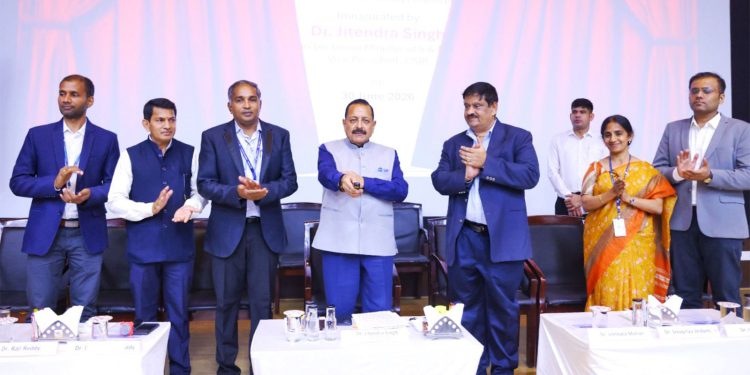
In a landmark event, Union Minister of State for Science and Technology, Dr. Jitendra Singh, officially inaugurated three highly advanced, future-ready facilities at the Hyderabad campus.
If you love seeing Hyderabad lead the way in national innovation, here is everything you need to know about what went down and why it matters.
What’s New at CSIR-IICT?
The newly unveiled infrastructure highlights a massive shift toward sustainable engineering and commercial science. The three major additions include:
-
An Effluent Treatment Plant (ETP) for Textile Wastewater: Addressing one of the biggest environmental challenges in manufacturing, this facility will provide advanced solutions to clean and recycle industrial textile waste.
-
A Continuous Processing Technologies Facility: A game-changer for the pharmaceutical and chemical sectors, allowing for safer, faster, and more efficient production of vital chemical compounds.
-
A Sustainable Engineering Complex: Dedicated to finding eco-friendly engineering solutions, keeping India on track for its green energy goals.
Elevating Hyderabad’s Scientific Footprint
Speaking at the inauguration, Minister Jitendra Singh praised the faculty and students of IICT, pointing out how much the visibility and public outreach of Council of Scientific and Industrial Research (CSIR) labs have grown over the last decade under Prime Minister Narendra Modi’s leadership.
“Each of the labs today is qualifying in one way or the other. There are a lot of advanced technological interventions happening at different levels,” Singh remarked, highlighting that the core strength of these new facilities lies in their direct link to real-world industries.
Turning Waste into Wealth
One of the most inspiring takeaways from the Minister’s visit was the focus on the circular economy and agricultural innovation. From converting captured carbon dioxide into Dimethyl Ether to producing compressed biogas from food and crop waste, Hyderabad’s scientists are literally turning trash into national treasure.
Dr. Singh stressed that India’s next phase of economic growth will be heavily driven by a new generation of agri-startups and agri-entrepreneurs. By taking technologies developed right here in Hyderabad and matching them with MSMEs and startups, the gap between academic research and commercial market success is closing faster than ever.
Why This Matters for Hyderabadis
For decades, CSIR-IICT has quietly been the backbone of India’s agrochemical, pharma, and biotech sectors. By introducing these advanced facilities, Hyderabad isn’t just maintaining its status as a tech hub—it’s actively paving the way for a cleaner, self-reliant, and technologically superior India.
The next time you pass by the iconic IICT campus in Uppal, take a moment to appreciate the world-class, planet-saving science happening right in our backyard!