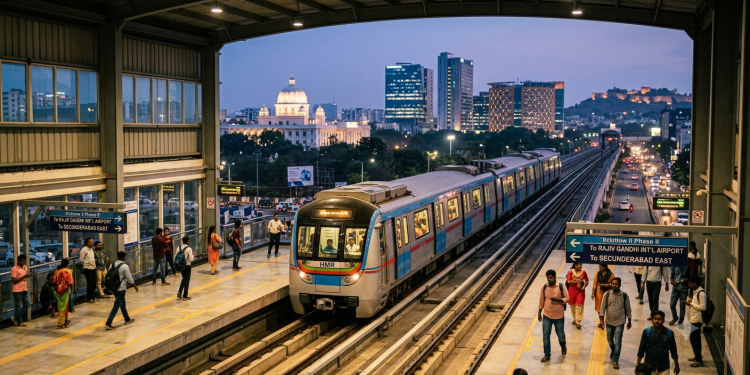
The Hyderabad Metro is tracking toward a massive transformation, but the most fascinating action isn’t happening on the rails—it’s happening behind closed doors in New Delhi and Hyderabad.
After years of maintaining a strict distance and letting the project run on a purely Public-Private Partnership (PPP) model, the Central Government has pulled a massive U-turn. New Delhi is officially stepping in to join forces with the Revanth Reddy administration just as Phase II expansion plans gear up.
Why the sudden change of heart? While the official narrative focuses on “urban development,” a closer look reveals a high-stakes game of political chess and multi-crore asset management.
1. The Battle for GHMC: Denying a Political Monopoly
In politics, timing is everything. With the Greater Hyderabad Municipal Corporation (GHMC) elections looming on the horizon, public infrastructure is the ultimate campaign currency.
Chief Minister Revanth Reddy was fully prepared to turn the Metro expansion into a cornerstone campaign issue. By threatening to bypass New Delhi and fund the 120-km Phase II expansion independently, the Congress-led state government was positioning itself to take sole credit for Hyderabad’s modern face-lift.
The BJP-led Central Government recognized the trap. By officially joining the project as an equity stakeholder, the Center effectively neutralizes this narrative. When the ribbon gets cut on Phase II, the credit will be shared, preventing the state government from weaponizing the Metro as a unilateral political victory during the municipal polls.
2. Guarding the Crown Jewels: The Multi-Crore Land Lockdown
Beyond politics lies a staggering financial reality: the Hyderabad Metro sits on transit-oriented development (TOD) land assets worth several thousand crores.
When L&T exited the project and left the state government holding 100% of the equity—along with a mountain of debt—alarm bells rang in federal financial circles. There were growing concerns that without adequate central funding, a cash-strapped state government might resort to aggressively monetizing or selling off these premium land parcels to keep the project afloat. Critics argued that stripping the Metro of its real estate assets would permanently cripple its long-term financial viability.
By stepping in as an official partner, the Central Government has effectively placed a lock on those assets. Once the Center becomes a legal stakeholder in the joint venture, the state government can no longer act unilaterally. Any decision regarding the sale, lease, or monetization of Metro land will require New Delhi’s explicit stamp of approval.
The Verdict: A Calculated Partnership
The decision to appoint SBI Caps to evaluate the Metro’s worth isn’t just about finding lower interest rates; it’s about drawing up the terms of a shotgun marriage. By coming on board, the Central Government accomplishes two things at once: it secures a front-row seat in Hyderabad’s biggest urban success story, and it ensures that the state’s most valuable public assets remain under joint federal watch.
For Hyderabadis, the political tug-of-war matters less than the destination. Whether driven by political rivalry or financial defense, the Center’s involvement likely means more financial stability, fewer delays, and a faster track toward a truly world-class transit system.