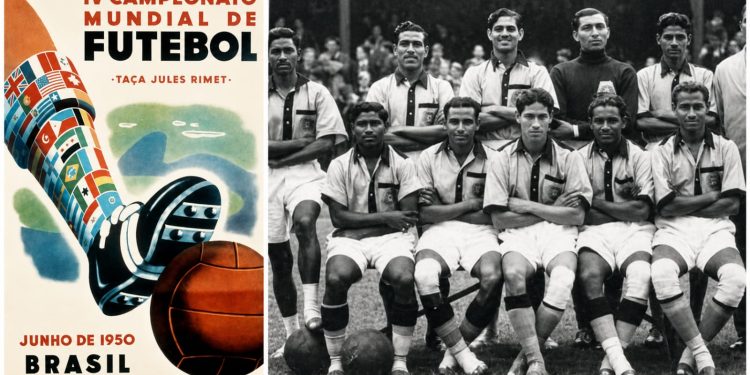
The first-ever FIFA World Cup kicked off in 1930, followed by editions in 1934 and 1938. Then came the devastating battles of World War II, which brought sports around the globe to a sudden standstill. After the war ended in 1945, FIFA began exploring how to revive the world’s greatest football tournament.
At the FIFA Congress of 1946, Brazil stepped forward with a bid to host the event in 1950. With global economies lying in shambles after the wreckage of the war, the football governing body eagerly accepted the offer. However, severe post-war financial constraints forced a shortened format.
FIFA capped it as a 16-team competition. Brazil (as the host) and Italy (as the defending champion) qualified automatically, leaving just 14 open slots. Europe claimed seven of these, and the Americas took six. That left exactly one solitary gateway for the entire continent of Asia.
When that rare Asian slot opened up for India, the stage was set for an unprecedented sporting milestone. Yet, the nation’s subsequent, sudden withdrawal didn’t just break hearts at a national level—it silently crushed the destiny of Hyderabad.
The Powerhouse of Indian Football
To understand why this hurt Hyderabad the most, one must understand the landscape of Indian football in 1950. The city was the undisputed nursery of the national team.
Under the sharp tactical vision of the legendary coach Syed Abdul Rahim, the Hyderabad City Police team was a domestic juggernaut. They didn’t just win trophies; they played a sophisticated, physically dominant style of football that was years ahead of its time. Had India boarded the plane to Brazil, the starting lineup would have been heavily anchored by Hyderabad icons like midfield engine Noor Mohammed, defensive rock S.K. Azizuddin, and the lethal forward Syed Khaja Moinuddin.
Instead, a series of bureaucratic excuses locked them out of history.
Debunking the Myths: Why India Stayed Home
For decades, the mainstream explanation was that India withdrew because FIFA banned barefoot play following the 1948 London Olympics. But the players themselves have since rejected this. Sailen Manna, the legendary Indian captain at the time, later clarified that playing barefoot was never a dealbreaker—the squad was entirely prepared to wear boots to compete on the world stage.
Then came the financial excuse. The All India Football Federation (AIFF) claimed the travel costs to South America were too high. Yet, history reveals that FIFA had offered to cover a massive $10,000 of India’s travel expenses, and local Brazilian organizers were ready to subsidize their stay just to ensure Asian representation.
The AIFF also cited a lack of practice time and selection issues. But in a post-war world, almost every participating nation faced identical logistical hurdles.
According to the late Novy Kapadia, the definitive voice on Indian football history, the real culprit was a monumental lack of institutional vision. The AIFF simply failed to realize the importance of the World Cup. To the federation’s bureaucrats, the Olympic Games were the absolute pinnacle of sport, and the FIFA World Cup was viewed as a distant, optional exhibition.
Because of this tragic miscalculation, India stayed home, and the entire continent of Asia went completely unrepresented in 1950.
A Tale of Two Destinies
While Hyderabad’s stars watched from afar, the tournament in Brazil reached a staggering, tragic climax.
In the final match at the colossal Maracanã Stadium, Uruguay pulled off the greatest shock in football history, defeating the hosts 2-1. The final whistle plunged Brazil into a state of collective national trauma. Millions wept, including a domestic footballer named João Ramos do Nascimento. Watching his father break down inconsolably, a nine-year-old boy walked into the room, comforted him, and made a historic vow: “Don’t cry, Papa. I will win the World Cup for you.”
That boy was Pelé.
The contrast is haunting. In Brazil, a national tragedy birthed the career of the greatest player the world had ever seen. In India, institutional shortsightedness quietly extinguished the global peak of Hyderabad’s finest generation.
The Hyderabad core went on to prove their mettle years later, forming the backbone of the Indian team that finished an incredible 4th at the 1956 Melbourne Olympics under Rahim saab. But the football world will always be left with a profound “what if.” If Hyderabad’s golden generation had been allowed to test their skills against the world’s best in 1950, Indian football history might look entirely different today.