If you look past the standard IT corridors and glittering high-rises of Gachibowli, Hyderabad is quietly cementing its reputation as the deep-tech capital of India. First, it was private rockets launching into space; now, it’s revolutionary aircraft taking off vertically from our own backyard.
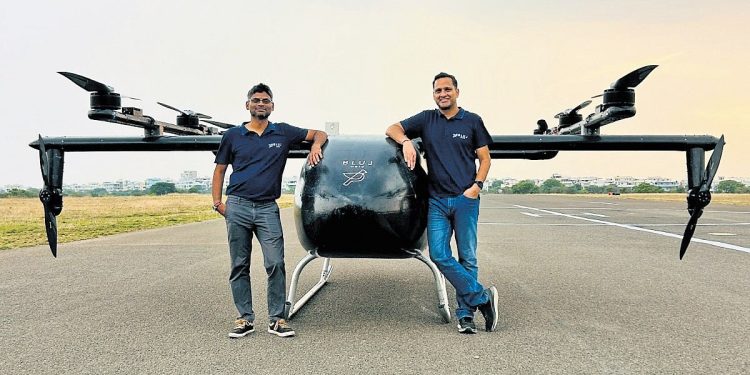
This week, city-based deep-tech aerospace startup BluJ Aerospace pulled back the curtain on “Gen #2”, a commercial-grade, heavy-payload electric Vertical Take-Off and Landing (eVTOL) aircraft.
Forget the far-fetched sci-fi dream of everyday passenger air taxis for a second. BluJ is solving a much more immediate, multi-billion-dollar problem: How do you move massive industrial and military cargo across India without relying on congested highways or non-existent rural roads?
Here is why this rollout is a massive milestone for India’s indigenous aerospace ecosystem.
Moving Beyond the “Prototype” Phase
Four years of intensive, in-house R&D have led to this moment. Earlier, BluJ made headlines when its Gen #1 tech demonstrator completed India’s first-ever public flight of a $500\text{ kg}$-class eVTOL.
But Gen #2 isn’t just an experiment; it’s an operational workhorse built for the real world.
   [ Vertical Lift ]       -->      [ Wing-Borne Cruise ]
(Hovers like a helicopter)         (Flies fast like an airplane)
Currently undergoing active transition flight testing—the critical phase where an aircraft switches from a vertical hover to wing-borne forward flight—the vehicle utilizes a highly efficient lift-plus-cruise configuration. It is fully battery-powered, boasting an upgraded high-voltage power system and a massive 40% reduction in airframe weight compared to its predecessor.
-
The Muscle: It is purpose-built to lift active payloads exceeding 200 kg within a $500\text{ kg}$ Maximum Take-Off Weight (MTOW) envelope.
-
The Mission: It is already deployed for early customer pilots, defense mission evaluations, and industrial logistics.
The Secret Sauce: What on Earth is VANTIS?
In aviation, designing an entirely new plane from scratch every time you want a different size is an easy way for a startup to go broke. BluJ solved this by introducing VANTIS—a proprietary, platform-based architecture.
Think of it like the shared chassis strategy used by car manufacturers. VANTIS standardizes the core airframe framework, flight control computers, and autonomy systems.
Because Gen #2 is built on this foundation, BluJ can scale up rapidly. Their upcoming one-tonne payload cargo variant and their long-range passenger aircraft (“Hop”) will inherit these exact same flight-proven subsystems. It means faster time-to-market, lower manufacturing costs, and compounding safety data with every hour flown.
Radically Autonomous, Proudly Made in Hyderabad
At their 40,000 sq. ft. facility in Hyderabad, a team of over 50 elite aerospace specialists are keeping things strictly homegrown.
To meet the rigorous compliance standards of the Indian military and critical infrastructure networks, BluJ maintains a strict zero-sourcing policy from China for critical components. Instead, they design and manufacture their own:
-
Proprietary high-density battery packs
-
High-voltage electronic boards & motor controllers
-
Custom aerodynamic propellers
This isn’t just assembly; it’s genuine, sovereign intellectual property being engineered right out of Telangana.
From Heavy Cargo to Long-Range Hydrogen (2027 & Beyond)
While pure battery power is perfect for the Gen #2’s immediate sub-10 km heavy lifting missions, BluJ’s long-term vision requires a different kind of fuel. Batteries are simply too heavy for inter-city travel.
The startup’s flagship commercial goals involve hydrogen-electric propulsion. They have already developed a ground version of an in-house Type IV composite hydrogen tank. To make sure these aircraft actually have places to fill up, they have strategically partnered with Bharat Petroleum (BPCL) and Cochin International Airport (CIAL) to pioneer the regional hydrogen-refueling infrastructure of tomorrow.