A billion-tonne cloud of magnetized plasma is currently hurtling through deep space at a staggering 1,400 kilometers per second. Its destination? Earth’s magnetic field. Its consequence? One of the rarest, most spectacular celestial light shows humanity has ever witnessed.
The cosmic clock began ticking on June 6, when a volatile eruption on the Sun launched this massive plasma wave directly toward us. The Space Weather Prediction Center has issued a G3 (“strong”) geomagnetic storm watch, warning that it could spike into a G4 (“severe”) event tonight. The storm is projected to peak right in the middle of our night—between 11:30 PM IST and 2:30 AM IST.
Internationally, it is a historic event. Skies across Scotland, Scandinavia, and Iceland will be flooded with ripples of green and purple visible to the naked eye. Seattle, Minneapolis, and vast swaths of Canada are sitting squarely in the splash zone. Even in the Southern Hemisphere, Tasmania and the tips of Argentina are bracing for a brilliant display of the Aurora Australis.
But if you are stepping out onto your balcony in Jubilee Hills or Gachibowli tonight hoping for a glimpse of the Northern Lights, you are out of luck. Hyderabad will miss the show entirely.
The Blind Capital and the Monsoon Shield
To understand why Hyderabad is sitting this one out, you have to look at a combination of bad timing, urban sprawl, and pure geography.
First, there is the weather. While Delhi is currently cloudless (though utterly blinded by its own massive, suffocating light pollution), Hyderabad, Mumbai, Bengaluru, and Chennai are firmly under the shadow of the summer monsoon. The thick, heavy cloud cover blanketed over the Deccan Plateau ensures that even if the sky did put on a show, we wouldn’t see a single spark.
But even on a perfectly clear night, geography is against us. Because India is situated at a low latitude, the classic green auroral curtains that we see in movies remain entirely below our physical horizon. When a solar storm is powerful enough to reach the subcontinent, it doesn’t look like curtains. It appears as a “Stable Auroral Red” arc—a delicate, high-altitude crimson glow created when solar particles collide with oxygen more than 300 kilometers above the Earth.
To see something that faint and that high, you need three things: extreme altitude to bypass the thickest parts of the atmosphere, zero light pollution, and a completely unobstructed northern horizon.
Hyderabad has none of those.
The Lonely Window in the Himalayas
Instead, there is exactly one place in India where the magic is real: Hanle, Ladakh.
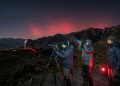
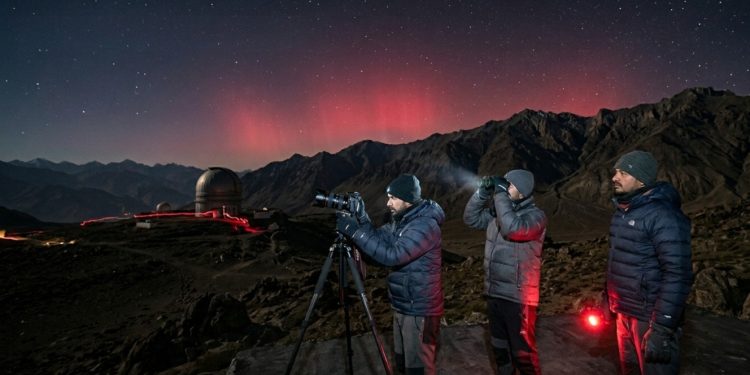
Perched at a breathless 4,500 meters above sea level in the Himalayan cold desert, Hanle is home to India’s Dark Sky Reserve and the Indian Astronomical Observatory. It rests right at the absolute southern edge of the global auroral oval.
The geography has already been proven. On January 19 earlier this year, the all-sky cameras at Hanle watched the pitch-black heavens turn a deep, eerie, cinematic red. Scientists at the Indian Institute of Astrophysics later confirmed it: a real aurora, burning silently above the snow-capped peaks.
Tonight, Hanle has a genuine shot at a repeat performance. Nearby high-altitude spots like the Nubra Valley, Pangong Tso, and the upper reaches of Uttarakhand carry a slimmer, but very real possibility.
For the handful of observers up there tonight, the instructions are simple: face north after midnight, find the darkest ground available, let your eyes adjust to the freezing darkness for 20 minutes, and point a long-exposure camera at the horizon. The lens will pick up a faint red and pink glow that the human eye can barely perceive.
That is as far south as the cosmic show will go.
So, as the rest of the world looks up in awe tonight, Hyderabadis can rest easy, pull up the blankets against the monsoon drizzle, and scroll through the photos tomorrow morning. Our skylines might stay masked by city lights and rain clouds, but somewhere high above the Himalayas, the universe is putting on a quiet, brilliant show just for us.